
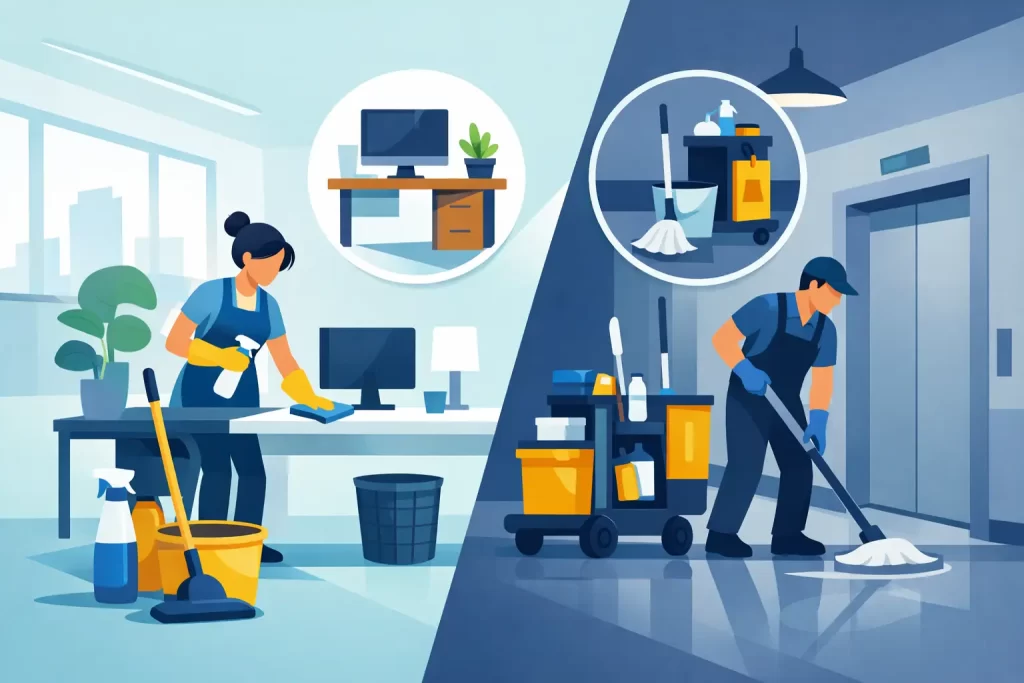
A lobby can look polished at 9:00 a.m. and still have overflowing trash, marked-up glass, and unsanitary restrooms by late afternoon. That is why the choice between office cleaning vs janitorial services matters. These terms are often used interchangeably, but they can describe very different service schedules, responsibilities, and levels of day-to-day support.
For a New Jersey business, the right choice depends on how your workplace is used, how many people move through it, and what standard of cleanliness your employees and customers expect. A small office that needs a detailed clean twice a week has different needs than a busy retail store or multi-tenant building that requires attention every day.
Office Cleaning vs Janitorial Services: The Main Difference
Office cleaning usually refers to scheduled cleaning focused on maintaining a clean, healthy, professional workspace. Service may take place once a week, several times per week, or on another recurring schedule that fits the office. The work often happens after business hours, before opening, or at a time when it will not disrupt employees.
Janitorial services typically involve more frequent, ongoing maintenance. A janitorial team may be responsible for daily restroom checks, trash removal, restocking supplies, cleaning spills, maintaining common areas, and responding to issues as they arise. Depending on the property, janitorial staff may work during business hours, overnight, or in shifts.
The difference is not always a strict line. Some cleaning companies use the terms broadly, and many businesses need a combination of both. What matters most is the scope of work written into your service plan. A dependable provider should clearly explain what is cleaned, how often it is cleaned, and who handles unexpected needs.
What Office Cleaning Usually Includes
Office cleaning is designed to keep work areas consistently presentable and sanitary without requiring staff on site all day. It works well for professional offices, smaller suites, agencies, law firms, medical administrative offices, and businesses with predictable traffic.
A recurring office cleaning plan commonly includes dusting desks and accessible surfaces, vacuuming carpets, mopping hard floors, emptying trash and recycling, sanitizing restrooms, and cleaning breakroom surfaces. Glass entry doors, conference rooms, reception areas, and high-touch points such as door handles and light switches may also be included.
The exact task list should match the space. For example, an office with carpeted private offices may need regular vacuuming and periodic spot treatment. A customer-facing showroom may need more attention on floors, windows, fixtures, and entry glass. If employees eat at their desks or frequently use a shared kitchen, the breakroom may require extra cleaning at every visit.
Office cleaning is often the practical choice when your primary concern is a consistently clean workplace at the start of each business day. It gives you an established routine without paying for an on-site cleaner throughout the day.
When Office Cleaning Makes Sense
Choose recurring office cleaning when your office is occupied mainly during standard business hours, trash and restroom use are manageable between visits, and you do not need immediate cleaning support every day. A two- or three-times-per-week schedule can be enough for many small and mid-sized offices.
It is also a strong option when you want service focused on detailed cleaning rather than supply management. If your internal team can handle a minor spill or replace a paper towel roll when necessary, a scheduled office cleaning plan may deliver the best value.
What Janitorial Services Usually Include
Janitorial services are built around ongoing upkeep. Rather than waiting for a scheduled evening clean, a janitorial plan can address the daily conditions that develop in active workplaces. This is especially valuable in spaces where appearance and sanitation cannot wait until the end of the day.
A janitorial team may handle routine trash removal, restroom cleaning and restocking, floor maintenance, litter pickup, touchpoint disinfection, spill response, and upkeep of shared spaces. In some facilities, janitorial staff also monitor consumables such as soap, toilet paper, paper towels, and liners.
The service can be customized around operating hours. A retail business may need frequent attention to fitting rooms, entrances, and restrooms while customers are present. A larger office may need a daytime attendant for common areas plus a deeper cleaning crew after closing. Schools, medical settings, warehouses, and high-traffic facilities often need a more active janitorial approach because cleanliness affects safety, comfort, and public confidence throughout the day.
When Janitorial Services Make Sense
Janitorial services are usually the better fit when a building has heavy foot traffic, public restrooms, multiple shifts, frequent customer visits, or large common areas. They are also helpful when a business needs quick attention to spills, trash buildup, restroom conditions, or other issues that can create an unpleasant impression.
A busy retail location is a good example. Even if the store receives a detailed clean after closing, its floors, entryway, restrooms, and trash cans can need attention before the day is over. Janitorial support helps prevent small issues from becoming visible problems for customers.
Frequency Changes the Cost and the Results
The price difference between office cleaning and janitorial services usually comes down to labor hours, frequency, building size, and service complexity. A recurring evening clean costs differently than a plan with daily visits or daytime staff. More frequent service generally means a higher investment, but it can also reduce the risk of neglected restrooms, overflowing waste, stained floors, and customer complaints.
It helps to look beyond the per-visit price. A low-cost plan that does not include the areas your business actually needs cleaned can create frustration and unexpected add-on charges. On the other hand, paying for daily on-site coverage in a quiet office with limited traffic may not be necessary.
Ask for a service plan that identifies the cleaning frequency for each area. Restrooms and breakrooms may need daily attention, while private offices may only need full cleaning two or three times per week. This approach gives you the level of service your business needs without treating every part of the building the same way.
Do Not Overlook Periodic Deep Cleaning
Neither office cleaning nor janitorial services automatically covers every larger cleaning project. Carpet extraction, floor stripping and waxing, interior window cleaning, detailed upholstery cleaning, and high-dusting are often scheduled separately. These services can be essential for maintaining the condition of your space over time.
Think of recurring cleaning as regular maintenance and deep cleaning as a reset. Both have a place in a professional facility. Floors may look acceptable with daily mopping, for example, but they can still need periodic treatment to remove embedded soil and preserve their finish.
If you are moving into a new office, reopening after construction, preparing for an event, or addressing a space that has fallen behind, start with a one-time deep clean. After that, a recurring office cleaning or janitorial plan will be more effective because the team is maintaining a clean baseline.
Questions to Ask Before Choosing a Provider
A reliable cleaning company should make it easy to understand exactly what you are purchasing. Before agreeing to service, ask whether the crew is professionally trained, whether the company is licensed, insured, and bonded, and how quality concerns are handled. You should also ask who provides cleaning supplies and whether consumables such as paper products are part of the service.
Clarify access procedures, security expectations, and communication. If the cleaning takes place after hours, you need confidence that the team can be trusted with your workplace. If you choose daytime janitorial support, you need staff who understand how to work professionally around employees and customers.
The best plan is not always the most frequent one. It is the one that keeps your workplace clean, healthy, and ready for the people who use it every day. JPR Cleaning helps New Jersey businesses build practical service plans around their space, traffic level, and schedule.
A clean facility should feel routine, not like a problem your team has to manage. Start by walking through your space at its busiest time of day, identify where cleanliness breaks down first, and use that real-world picture to choose the service level that will keep your business looking its best.