
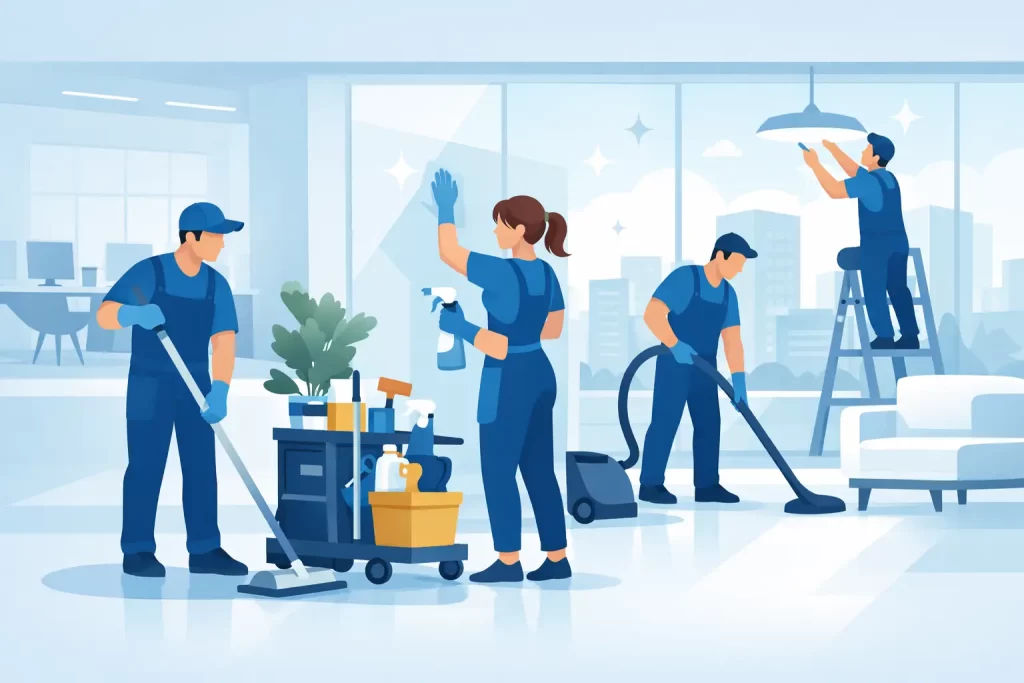
If you are comparing providers for your office, store, or shared facility, understanding commercial cleaning services meaning helps you ask better questions and choose the right level of care. It is not just about making a space look tidy. Commercial cleaning is a professional service built around keeping business environments clean, sanitary, safe, and ready for employees, customers, and daily operations.
A lot of people use the term loosely. They may mean janitorial work, office cleaning, deep cleaning, or general maintenance. In practice, commercial cleaning services usually refers to cleaning performed in business settings by trained crews using professional methods, equipment, and products. The goal is consistent results that support health, appearance, and day-to-day function.
Commercial cleaning services meaning in plain terms
The simplest way to define commercial cleaning services meaning is this: cleaning work provided for commercial properties rather than private homes. That includes offices, retail stores, medical offices, warehouses, apartment common areas, schools, and other workplaces or public-facing facilities.
The difference matters because business spaces have different demands. They often have higher foot traffic, shared restrooms, break rooms, reception areas, and stricter expectations around sanitation and presentation. A cleaning plan for a business also has to work around operating hours, employee schedules, customer flow, and security procedures.
Commercial cleaning can be scheduled daily, several times a week, weekly, or as a one-time service. Some businesses need ongoing upkeep. Others need occasional help after construction, before inspections, during seasonal traffic spikes, or after a special event.
What commercial cleaning usually includes
The exact scope depends on the property, but most commercial cleaning services cover the routine tasks that keep a business usable and professional-looking. That often includes dusting surfaces, vacuuming carpets, mopping floors, disinfecting high-touch areas, cleaning restrooms, emptying trash, wiping common areas, and maintaining kitchens or break rooms.
For offices, the focus is usually workstations, conference rooms, reception areas, floors, and restrooms. For retail stores, more attention may go to entrances, display areas, fitting rooms, counters, and customer-facing floors. In multi-use facilities, the plan may also include stairwells, elevators, hallways, and shared spaces.
Some providers also offer deeper specialty work like carpet cleaning, floor stripping and waxing, interior window cleaning, post-construction cleanup, and sanitation-focused treatments. That is where it helps to be specific. Not every commercial cleaning company includes every task in a standard visit.
Commercial cleaning vs. janitorial services
This is where people get confused, and fairly so. Commercial cleaning and janitorial services overlap, but they are not always used the same way.
Janitorial service often refers to routine, ongoing maintenance. Think daily or weekly cleaning that keeps a building in order. Commercial cleaning can include that same recurring work, but it may also cover more specialized or project-based services, including deep cleaning and higher-level floor care.
Some companies use the terms interchangeably. Others separate them by scope. That means the real question is not what label a company uses. It is what they will clean, how often they will clean it, and what standard they will be held to.
Why businesses hire commercial cleaning services
Businesses do not hire professional cleaners just to make a good impression, although that matters. They hire them because a clean space affects more than appearance.
A well-maintained workplace supports employee comfort and reduces the buildup of dust, germs, and mess in shared areas. In customer-facing spaces, cleanliness shapes trust almost immediately. People notice dirty floors, smudged glass, overflowing trash, and neglected restrooms faster than most owners realize.
There is also the practical side. Staff members are rarely hired to clean, and asking them to do it usually leads to inconsistent results. A trained commercial cleaning team brings a system. That includes the right supplies, safe handling practices, and a schedule that keeps cleaning from getting skipped when business gets busy.
Who needs commercial cleaning services?
Any business or property manager responsible for a shared or customer-facing space can benefit from commercial cleaning. Office managers often need recurring service to maintain work areas and restrooms. Retail operators need floors, entryways, and checkout areas kept clean so the business looks ready for customers. Building managers may need common-area cleaning in apartment or mixed-use properties.
Even smaller businesses that think they can manage cleaning in-house often reach a point where it no longer makes sense. Once cleaning starts taking time away from staff, affecting presentation, or falling behind sanitation needs, outsourcing becomes the more dependable option.
It also depends on the type of business. A small private office may only need service once a week. A busy storefront or medical-adjacent office may need much more frequent attention. There is no one-size-fits-all plan, which is why a walkthrough and a clear estimate matter.
What to expect from a professional provider
A professional commercial cleaning company should do more than show up with supplies. They should be able to explain their service plan clearly, outline what is included, and adjust the schedule to fit your building and business hours.
Reliability is a big part of the value. If a cleaning company misses visits, rotates untrained staff, or leaves tasks half-done, the problem shows up quickly in the space. That is why many businesses look for trained crews, strong communication, and trust signals like being licensed, insured, and bonded.
Those details are not just for paperwork. They help protect your business and provide peace of mind when a team is working in your office, store, or facility after hours or around sensitive areas.
How pricing works
Commercial cleaning prices vary because buildings vary. Square footage matters, but it is not the only factor. The number of restrooms, floor types, traffic level, frequency of service, and any specialty tasks all affect cost.
A smaller office with light traffic may be straightforward. A retail space with constant foot traffic and frequent floor attention may require more labor. A facility that wants nightly cleaning will naturally be priced differently than one that needs weekly service.
The lowest quote is not always the best value. If a price seems unusually low, it may mean reduced scope, rushed work, or inconsistent staffing. A better approach is to compare what is actually included, how often service is provided, and whether the company has a reputation for doing the job right.
How to choose the right commercial cleaning company
Start with clarity about your own needs. Do you need routine office cleaning, periodic deep cleaning, or support for a high-traffic customer space? Are there security protocols, access restrictions, or health-focused concerns that the cleaner needs to understand?
From there, look for a company that communicates directly and professionally. A dependable provider should be willing to assess the property, explain the cleaning plan, and give a clear estimate without vague promises. They should also be able to tell you who is entering your building and how service quality is managed.
Experience matters, but fit matters too. A company can have years in business and still not be the right match for your property type or expectations. The best choice is usually a provider that combines professional standards with consistent service and responsiveness. That is the reason many New Jersey businesses look for a team like JPR Cleaning that emphasizes trained staff, accountability, and dependable results.
Common misunderstandings about commercial cleaning services meaning
One common misunderstanding is that commercial cleaning only applies to large office buildings. In reality, small offices, retail shops, community spaces, and mixed-use properties all fall under the commercial category.
Another misunderstanding is that commercial cleaning always means a basic wipe-down. It can, but it can also include detailed sanitation work, floor care, and customized service plans built around a facility’s needs.
The last big misconception is that all cleaning companies offer the same thing. They do not. Some focus on speed, some on low-cost maintenance, and some on a more thorough, professional standard. That is why definitions help, but scope matters more.
When you understand commercial cleaning services meaning, you are in a better position to choose a service that protects your workplace, supports your image, and gives you one less thing to manage. A clean business runs better when the work behind it is consistent, professional, and built around what your space actually needs.