
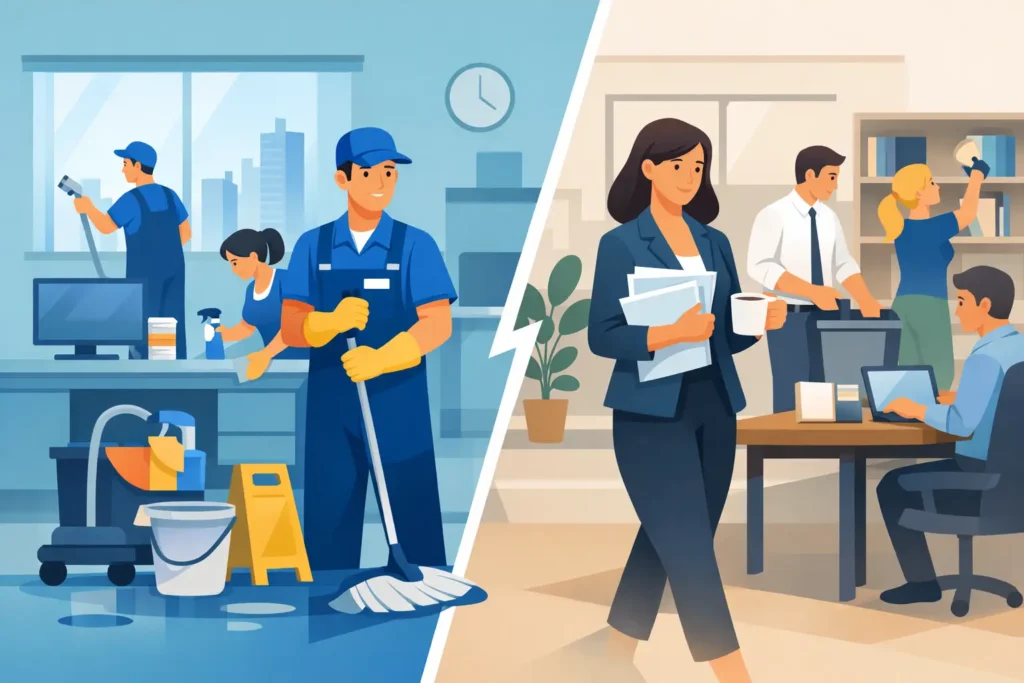
A cleaner office is not just a line item on a budget. It affects the way employees feel when they arrive, what clients notice during a visit, and how confidently your business operates. When weighing office cleaning vs in house staff, the right decision comes down to more than the hourly cost. You need to consider consistency, accountability, training, coverage, and the real amount of management time each option requires.
For some businesses, an internal employee can make sense. For many offices, retail locations, and professional spaces, a commercial cleaning company provides more dependable results with fewer moving parts. The best choice depends on the size of your facility, how often it needs attention, and the level of cleaning expected by your team and customers.
The Real Cost of In-House Cleaning Staff
Hiring an employee to clean your office may appear less expensive at first. You set the schedule, pay an hourly wage, and have someone assigned to the building. But wages are only one part of the cost.
An in-house cleaner may also require payroll administration, workers’ compensation, benefits, paid time off, onboarding, supervision, and replacement coverage when they are sick or unavailable. Your business also needs to purchase cleaning products, equipment, paper goods, and specialty supplies. If equipment breaks or supplies run low, someone on your staff must handle it.
There is also the cost of lost focus. Office managers and business owners are hired to keep operations moving, serve customers, and support employees. When they are checking restrooms, restocking supplies, addressing missed trash removal, or trying to find a last-minute replacement cleaner, they are spending time outside their core role.
For a very small office with light cleaning needs, those trade-offs may be manageable. For a growing business, they often become an ongoing burden.
What Professional Office Cleaning Includes
A professional cleaning service is built around a defined scope of work and a reliable schedule. Instead of asking a staff member to fit cleaning in between other responsibilities, you have trained cleaners focused on the job.
The service can be tailored to your workplace. A typical office cleaning plan may cover desks and common surfaces, restroom sanitation, trash and recycling removal, vacuuming, mopping, breakroom cleaning, and touchpoint disinfection. Retail businesses may need special attention on glass doors, checkout areas, fitting rooms, and floors. Medical-adjacent offices, salons, and high-traffic locations may require more frequent sanitation.
With a qualified provider, cleaning is handled by a team that knows how to work efficiently without disrupting your staff. Professional cleaners also understand the difference between making a space look tidy and cleaning it thoroughly enough to support a healthier workplace.
Office Cleaning vs In House Staff: Reliability Matters
Reliability is where outsourced cleaning often has a clear advantage. One internal cleaner means one point of failure. If that person calls out sick, takes vacation, leaves the company, or cannot complete the work, the office may go uncleaned.
A professional cleaning company has systems for scheduling, staffing, quality control, and backup coverage. That does not mean every provider performs at the same level. It does mean you should look for a company that is responsive, experienced, and clear about how it handles missed service or special requests.
For businesses that host clients, maintain regular office hours, or operate a retail location, consistency protects your reputation. Overflowing trash, streaked glass, or an unclean restroom can change a visitor’s impression in seconds. Employees notice, too. A well-maintained workplace shows that their comfort and health matter.
Training, Safety, and Accountability
Cleaning sounds straightforward until you consider the details. Different surfaces require different products. Restrooms need proper sanitation. Floors can be damaged by the wrong method or chemical. High-touch areas need regular attention, especially during cold and flu season.
An internal employee may be dependable and hardworking but still need training in commercial cleaning methods. They may also need guidance on chemical handling, storage, safety procedures, and equipment use. If cleaning is only one of their responsibilities, it can be difficult to maintain the same standard every day.
A professional provider should arrive with trained staff, established processes, and commercial-grade tools appropriate for the space. For added reassurance, choose a company that is licensed, insured, and bonded. Those credentials matter when outside professionals are working in your office after hours or around valuable equipment and confidential areas.
Accountability should be clear as well. You should know who to contact if priorities change, a special event is coming up, or an area needs extra attention. The right cleaning partner makes communication simple instead of making you chase down answers.
Control Is Not the Same as Constant Supervision
Some business owners prefer in-house staff because it feels like they have more control. There is value in having an employee on site, particularly when your building needs daytime maintenance, immediate spill response, or continuous upkeep throughout the day.
But control should mean having clear expectations and dependable results, not having to inspect every task. With an outsourced service, you can set the schedule, define priorities, request particular products or procedures, and adjust the cleaning plan as your needs change. You retain control over the outcome while the provider handles the staffing and execution.
This arrangement works especially well for offices that need evening or weekend cleaning. Your employees can work without interruptions during the day, then return to a fresh, orderly space the next morning.
When In-House Staff May Be the Better Fit
There are situations where keeping cleaning in-house is practical. A large facility that needs a full-time daytime custodian may benefit from an employee who can respond immediately to spills, deliveries, room setups, and maintenance concerns. Businesses with unusual security requirements may also prefer a dedicated internal team member.
Even then, many organizations use a hybrid approach. An in-house facilities employee handles daily needs, while a professional cleaning company performs detailed evening cleaning, floor care, deep restroom sanitation, or periodic projects. This can prevent your internal staff from becoming stretched too thin.
The key is being honest about what your employee can reasonably accomplish. Asking one person to manage supplies, handle maintenance, respond to requests, clean restrooms, vacuum every office, and deep-clean breakrooms often leads to inconsistent results.
Questions to Ask Before You Decide
Before choosing between an employee and a cleaning company, look at your needs over a full month rather than a single shift. Consider the number of employees and visitors, the amount of foot traffic, the condition you want clients to see, and the areas that require regular sanitation.
Ask whether your current approach provides coverage when someone is out. Consider who buys and stores supplies, who checks the quality of the work, and who handles cleaning emergencies. Finally, calculate the total cost of labor, payroll obligations, supplies, equipment, supervision, and replacement coverage instead of comparing hourly rates alone.
For many New Jersey businesses, professional office cleaning delivers the stronger value because it turns a time-consuming responsibility into a dependable service. JPR Cleaning provides professionally trained staff for businesses that want a clean, healthy, and welcoming environment without adding more to their internal workload.
A clean office should feel automatic to your employees and reassuring to every visitor. Choose the option that gives your business the consistency, care, and accountability needed to keep it that way.